





Choosing PrestaShop is associated with freedom. Open source, access to the code, the ability to freely develop the store and the ability to change providers - these are some of the biggest advantages of this technology over closed SaaS solutions.
But open source doesn't always automatically mean no vendor lock-in.
Vendor lock-in is a situation in which a company becomes dependent on one technology, module, system or agency provider and finds it difficult to change the solution later without great cost, risk or redesign.
In the context of PrestaShop, this can mean, for example, a module that cannot be easily replaced, code written in such a way that rebuilding the store is the only resort, or a contract that forces the store to continue working with a particular vendor.
In short: vendor lock-in is a technological dependency that limits a store's freedom of development.
In practice, a store can become dependent on a module, license, agency or code that no one but the current supplier wants to take over. The problem becomes especially apparent when a popular integration stops being developed, doesn't work with a newer version of PrestaShop or PHP, and its code is encrypted or obfuscated and nothing can be done about it.
At PrestaShow, we are familiar with this problem. That's why we design our PrestaShop modules to give merchants not only features, but also predictability, stability and security for further development.
We encrypt ionCube modules, but don't build vendor lock-in
Each of our modular solutions has unique value, often unavailable in competing products from other vendors. At PrestaShow, we secure some of our modules using ionCube, and we do this to protect the intellectual property, know-how and solutions we develop as a PrestaShop module developer.
We encrypt only the business logic of the module. All the code responsible for the front-end, translations and database is open and you can work with this code without any restrictions.
At the same time, we understand the concerns of merchants.
An encrypted module can raise questions:
- what happens if the module stops being developed?
- will the module work with future versions of PrestaShop?
- won't a PHP update block the module from working?
- Will the customer become dependent on a single provider?
- Is it possible to safely develop the store in the future?
Therefore, at PrestaShow, code encryption does not mean lack of responsibility. On the contrary, we treat it as a commitment to clear rules, guarantees and long-term support.
We guarantee updates and module development
A PrestaShop module should not be a one-time purchase without a future. Especially if it is responsible for an important process in the store: payments, deliveries, invoices, marketplace, affiliate or loyalty program, integration with ERP, product synchronization, product feeds or automation in the back-end.
That's why, for our modules, we offer an update and development guarantee for a certain period of time after purchase, and the option to extend support at any time.
This means that the customer is not left alone with a product that only works "for today." Our goal is to maintain the modules so that they can support the store through the long stages of its development.
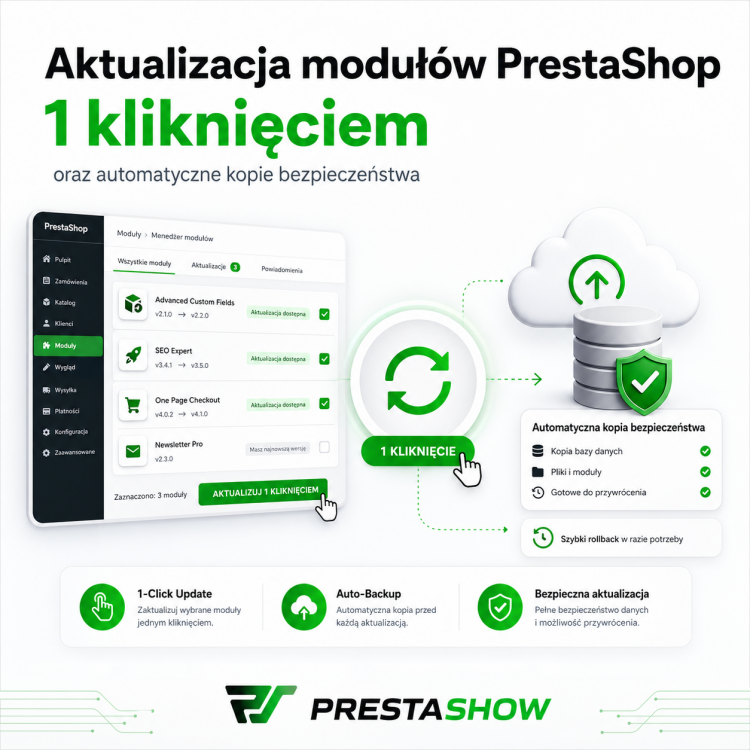
We quickly adapt modules to new versions of PrestaShop and PHP
One of the biggest problems in eCommerce is when a store can't be updated because it is blocked by one module.
At PrestaShow, we design modules ahead of time and think about compatibility with future versions of PrestaShop and PHP. As part of our active support, we make sure that our solutions are adapted to technological changes.
We are the only ones in the market to guarantee the compatibility of our modules (May 2026) with any sub-version of PrestaShop 9.x and with PHP up to and including version 8.5.
If we have released a module for e.g. PrestaShop version 9 then we guarantee that it will get updates for every subsequent sub-version of that PrestaShop version.
This is important because the lack of updates over time affects security, performance and the ability to further expand the store.
If we finish developing the module, we will provide a backup plan
The biggest problem with an encrypted or obfuscated module occurs when its author abandons the product. The merchant is left with a solution that he can't easily improve, expand or adapt to new versions of the system.
At PrestaShow, we rule out such a scenario and adopt a principle:
If we terminate the development of a module, we will provide a contingency plan: release an open source version or hand over the source code in a formula that allows us to continue to maintain and develop the module ourselves.
We do not want our modules to become a technology trap.
Since 2018, we have been developing and updating all modules in our portfolio, so that almost every module in our store works with PrestaShop from 1.6 to 9.x inclusive.
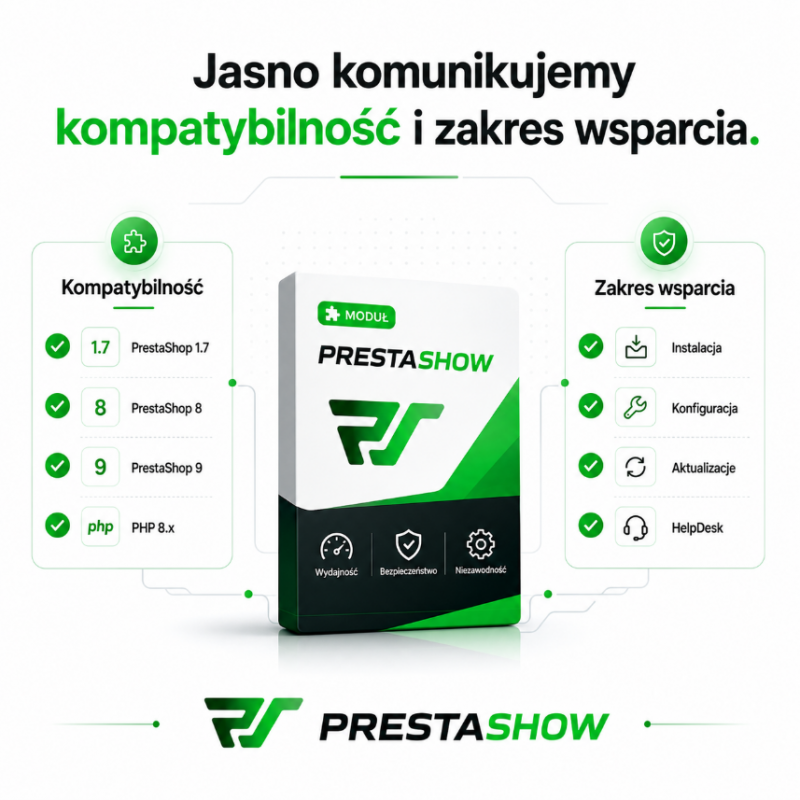
We clearly communicate compatibility and scope of support
As a module provider, we clearly communicate what the customer is buying and on what terms, which is why at PrestaShow we pay attention to:
- possibility to test the module before purchase
- guarantee of operation and free installation after purchase
- compatibility of modules with PrestaShop versions,
- compatibility with PHP versions,
- history of changes (precise changelog),
- scope of support,
- update policy,
- plans for further development,
- the module's impact on the store's critical processes.
This allows the merchant to make an informed decision and assess whether the solution fits his store not only today, but also in the years to come.
We protect the customer from dependence on one supplier
We work on modules so that the customer using PrestaShow modules and development services can be sure that:
- the modules and services we serve are implemented in accordance with PrestaShop documentation, standards and good practices
- the modules are developed and regularly updated,
- the module will not block the development of the store,
- changes in PrestaShop and PHP will be taken into account,
- code encryption will not become a business problem,
- in the event of termination of product development - there will be a clear exit plan.
This is what we mean by responsible development of PrestaShop modules.
A module is not just a function. It is an element of the store's infrastructure
A good PrestaShop module should not only add a function. It should be a stable element of the store.
If a module handles payments, deliveries, ERP integration, invoices or marketplace, its failure can stop sales. If it's not updated, it can block store migrations. If it lacks support, it can generate a costly problem.
At PrestaShow, we look at modules as part of the eCommerce infrastructure. We create modules to support the growth of the store, not to limit it after a few months or years.
To offer the highest quality we provide support. Our HelpDesk panel is available to merchants 24/7.
Our values when developing PrestaShop modules
We follow several principles when designing and developing modules.
- 1 Stability. The module must work predictably and securely in a real store.
- 2 Compatibility. The solution should be ready for the development of PrestaShop, PHP and external integrations.
- 3. Responsibility. If we sell the module, we take responsibility for its continued maintenance.
- 3. contingency plan. We guarantee to release an open source version or hand over the module's code when we stop developing the module.
What about implementations and development services for PrestaShop?
Although the main topic of this post is modules, we also apply the same approach to PrestaShop store implementations, which our agency has been doing for a decade.
PrestaShop gives merchants freedom. Our job is not to take that freedom away.
We design, build and develop stores so that they can be updated, maintained and expanded. We care about the quality of the code, compliance with good practices and PrestaShop documentation, the architecture and the possibility of further development. We don't want to create stores that only work until the first major update.
Summary
Encrypting ionCube modules does not have to mean vendor lock-in. The problem is not in the security of the code itself, but in the lack of accountability, updates, warranties and a contingency plan.
At PrestaShow, we secure our solutions, but at the same time we guarantee our customers stability, development and security. We create PrestaShop modules to support stores for years, not to block their future.
If you're choosing a module for your store, don't just ask if it works today.
Also make sure it will be safe for your business tomorrow.
FAQ
Are PrestaShow modules encrypted?
Yes, some PrestaShow modules are secured using ionCube. We do this to protect the intellectual property and solutions we develop as a PrestaShop module manufacturer.
Does ionCube encryption mean vendor lock-in?
Not in our approach. Code encryption should not mean customer dependency on the vendor. That's why we provide updates, development, PrestaShop and PHP compatibility, and a contingency plan in case the module development is terminated.
What happens if PrestaShow stops developing the module?
In such a situation, we will provide customers with a viable exit plan - releasing an open source version, handing over the source code, or some other solution to continue maintaining the module.
Will PrestaShow modules be updated to new versions of PrestaShop?
Yes, our goal is to keep the modules compatible with current and upcoming versions of PrestaShop within the framework of a specific support and update policy, which is announced on each module's page.
Will PrestaShow modules be adapted to new PHP versions?
Yes. Compatibility with new PHP versions is one of the key elements of module maintenance, as it affects the security, performance and upgradeability of the store.
Why are abandoned PrestaShop modules a problem?
An abandoned module can block store updates, cause bugs, hinder development or force a costly rewrite of features from scratch. The risk is higher when the module's code is encrypted and the vendor does not provide a backup plan.
How to choose a secure PrestaShop module?
It's a good idea to check who develops the module, how long they provide support, whether the module is updated, what versions of PrestaShop and PHP it is compatible with, and what happens if the vendor ends its development.
Does PrestaShow also create dedicated PrestaShop modules?
Yes. We create both off-the-shelf modules and dedicated solutions for PrestaShop stores, including integrations with ERP, marketplace, payment systems, delivery, wholesalers and other eCommerce tools.