Customer service and order packaging on your phone 📦








International sales, languages and domains
9 services for your PrestaShop store
Modules to support the development of foreign sales in PrestaShop: support for multiple languages, domains, currencies and configuration of the store for different markets.
International sales, languages and domains
- 4.5
 Free support BESTfrom 100,00 EUR
 Free support New75,00 EUR
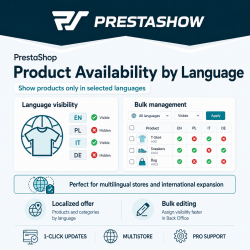 Free support150,00 EUR
- 5.0
 Free support BEST200,00 EUR
- 4.9
 Free support BESTfrom 150,00 EUR
- 5.0
 Free support
 Free support
 Free support100,00 EUR
How do PrestaShop modules help grow international sales?
PrestaShop modules help you prepare your store to sell in multiple markets without having to rebuild the entire platform. With them, you can implement additional languages, currencies, local payment methods, international shipping, product feeds, international SEO, and marketplace integrations.
When expanding internationally, modules that streamline customer communication and automate sales are particularly important. The store should display the correct language, currency, shipping costs, consents, terms and conditions, and messages tailored to the customer’s country. In larger implementations, this also includes the synchronization of products, inventory levels, prices, and orders between PrestaShop, ERP systems, OMS systems, wholesalers, and marketplaces.
Do I need Multistore for international sales in PrestaShop?
Not always. If you’re selling in several markets with a similar product lineup, a single PrestaShop installation with multiple languages, currencies, and localization modules is often sufficient. A multistore setup is worth considering if each country is to have a separate domain, different prices, a different product lineup, separate integrations, separate shipping settings, or a separate customer service team.
Which PrestaShop modules are most important when expanding into other countries?
Not always. If you’re selling in several markets with a similar product lineup, a single PrestaShop installation with multiple languages, currencies, and localization modules is often sufficient. A multistore setup is worth considering if each country is to have a separate domain, different prices, a different product lineup, separate integrations, separate shipping settings, or a separate customer service team.