





AI Act Effective August 2, 2026: How to Label AI Images in a PrestaShop Store?
Starting August 2, 2026, the transparency requirements set forth in Article 50 of the EU AI Act will apply. Does this mean that every product description, banner, and image enhanced using artificial intelligence must be labeled “AI”? No. For online store owners, the most important thing is to distinguish between ordinary editing and content generated or substantially altered by AI that a customer might perceive as authentic.
This distinction is particularly important in e-commerce. The legal definition of a “deepfake” is not limited to fake recordings of politicians or celebrities. It also includes realistic images resembling real people, objects, places, entities, or events. In practice, this may therefore also apply to photos of products, models, interiors, displays, and promotional materials used in an online store.
In this guide, we explain what changed on August 2, 2026, which materials in an online store may require labeling, and how to manage this process in PrestaShop.
Important: This article is for informational purposes only and does not constitute legal advice. For unusual campaigns, regulated products, and claims regarding health, safety, or the environment, it is advisable to consult a lawyer regarding how to publish such content.
What exactly changed on August 2, 2026?
Article 50 of the AI Act introduces several different transparency obligations. From an online store’s perspective, the following four situations are the most important:
- the customer engages in a direct conversation with an AI system, such as a chatbot or virtual advisor;
- a generative system creates or modifies text, images, audio, or video;
- a company uses an emotion recognition or biometric categorization system;
- the company publishes a deepfake or text concerning matters of public interest that has not undergone actual human review.
- In e-commerce, the labeling of photos and videos raises the most questions. It’s important to distinguish right away between two obligations that are often confused with one another.
| Type of labeling | Who is responsible for it? | What does this mean in practice? |
| Technical, machine-readable | Generative system provider | The tool should include features that allow for the detection of synthetic content, such as metadata or Content Credentials. The store should not remove them. |
| Visible or audible to the recipient | The entity publishing the material, which is most often the store | If the material is a deepfake, the customer should receive clear information, no later than upon first contact, that the content was generated or modified by AI. |
For generative systems introduced to the market before August 2, 2026, a transition period for technical labeling is provided through December 2, 2026. However, this does not defer the obligation of the publisher to disclose deepfakes. The scope of the exception is confirmed by the European Commission’s official summary.
The European Commission also clarifies that there is no obligation to retroactively label deepfakes generated before August 2, 2026. Voluntary labeling, however, can still increase transparency and customer trust.
Does every image created using AI need to be labeled?
No. The mere use of artificial intelligence does not, in itself, determine the need to include a visible label.
For an image to be considered a deepfake under the AI Act, three elements must be present:
- The image was generated or modified using AI.
- It resembles an existing person, object, place, entity, or event.
- The audience for whom the material is intended could mistakenly believe it to be authentic or real.

If the image is clearly illustrative, abstract, or fantastical and does not purport to be a real photograph, it generally does not meet the definition of a deepfake.
Similarly, standard editing—such as adjusting exposure, white balance, or focus; minor cropping; or noise reduction—generally does not require visible labeling, provided it does not significantly alter the content or meaning of the image.
The line is drawn where AI begins to create reality, rather than merely making technical improvements to the material.
AI Photos in an Online Store—Practical Examples
| Product images in an online store | Likely rating | Recommended action |
| Cropping, color correction, noise reduction, or sharpening | Standard editing, provided it does not alter the appearance or meaning of the content | A visible label is usually not necessary. |
| A real product placed by AI against a realistic, generated background | The AI significantly alters the scene, which the client may perceive as an authentic photo | Label the material and specify that the background or arrangement was generated or altered by AI. |
| A photorealistic packshot of an existing product generated from scratch | The image may be perceived as an authentic product photograph | Apply a visible label and verify that the visualization matches the actual product. |
| Product “enhanced” by AI: altered color, shape, texture, or features | Significant manipulation and an additional risk of misleading the customer | An AI label is not sufficient. The material should not depict features that the product does not have. |
| A realistic model, influencer, or product presenter generated or modified by AI | The material may look like a photograph of a real person or situation | Use clear labeling, especially if the viewer might perceive the scene as authentic. |
| A diagram, icon, drawing, or obviously unrealistic illustration | This is usually not a deepfake because it does not masquerade as an authentic photograph | A visible label is usually not required, though technical origin markers should not be removed. |
| Image generated before August 2, 2026 | No retroactive labeling requirement | You may label it voluntarily, especially if the material could influence a purchasing decision. |
It’s advisable to apply the precautionary principle to sales materials. If a customer might interpret the visualization as proof of the product’s actual appearance, use, or performance, the disclosure regarding AI use should be unambiguous. The disclosure alone does not legitimize an image that misleads about the product’s characteristics.
What about AI-generated product descriptions?
Article 50 does not automatically require labeling every product description created using ChatGPT or another text generator.
A specific obligation applies to texts published to inform the public about matters of public interest if they were generated or modified by AI and have not undergone human editorial review. A typical product description does not fall into this category. Additionally, actual substantive verification and the identification of the person or company responsible for the publication also exempt such texts from this obligation, even if they concern matters of public interest.
This does not mean, however, that a description can be published without any review. The seller remains responsible for the accuracy of specifications, instructions, warnings, prices, and marketing claims. Statements regarding health, safety, and the product’s environmental impact require special verification.
What should the labeling of AI-generated content look like?
The AI Act does not impose a single mandatory phrase or graphic. The information must be clear, distinguishable, accessible, and provided no later than the recipient’s first encounter with the material.
In an online store, the following messages, among others, can be used:
- “Image generated by AI”;
- “Image modified using AI”;
- “Product visualization generated by AI”;
- “The background of this photo was generated by AI.”
A small icon with just the letters “AI” may be unclear to some customers. It’s safer to combine a short badge with a full description that appears when clicked, hovered over, or directly below the photo. The label should not rely solely on color and should also be understandable to users of assistive technologies.
Placement also matters. If a customer first sees the photo in a category list, having the label appear only on the product page may be too late. The mechanism should account for all locations where a given image is displayed.
How do you tag hundreds of AI images in PrestaShop?
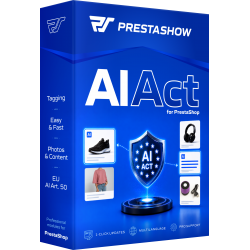
In a small catalog, photos can be checked manually. With hundreds or thousands of products, manual checking quickly becomes impractical. That’s why at PrestaShow we’ve developed a module for AI content labeling in PrestaShop. The module:
- uses AI to analyze all images in the store;
- It analyzes not only images in the product gallery but also those in categories, banners, CMS content, and materials added by various modules over the years;
- allows the administrator to confirm and tag images that meet the established rules;
- also allows images to be labeled manually;
- enables the administrator to change or correct decisions;
- helps maintain a consistent approach to informing customers throughout the entire catalog.
Automatic analysis organizes the catalog and flags content requiring attention, while manual control allows for context that the system cannot always properly assess. The module supports auditing and the publication of labels, but the final decision should remain with the person responsible for the store.
 Free support50,00 EUR

A Quick Checklist for Store Owners
- Take inventory of images and videos. Include products, categories, banners, the blog, the CMS, and ads.
- Distinguish between routine editing and significant manipulation. Not every retouch requires a disclosure.
- Consider the customer’s perspective. Could the material look like a real photograph of a product, person, place, or event?
- Establish consistent labeling conventions. At a minimum, distinguish between content generated from scratch and content modified by AI.
- Display the information upon the user’s first interaction with the image. Remember to include product listings, search results, and promotional modules—not just the product page.
- Do not remove source metadata. Technical identifiers from the tool provider and visible information for the customer serve different purposes.
- Leave room for manual corrections. Automated analysis helps with large catalogs, but it doesn’t know the full context of the image’s creation.
- Establish guidelines for working with agencies and freelancers. Content providers should disclose whether and how they used AI.
- Document your decisions. It’s a good idea to record who marked a particular piece of content—or chose not to—and why.
Penalties and Liability
According to the European Commission’s official summary, a violation of the AI Act’s obligations—other than prohibited practices—may result in a fine of up to 15 million euros or — in the case of a company — up to 3% of its total worldwide annual turnover from the previous year, whichever is higher. The principle of proportionality applies when imposing penalties, including a special approach for smaller companies.
In Poland , the Act of July 3, 2026, on Artificial Intelligence Systems established the Commission for the Development and Safety of Artificial Intelligence as the national market surveillance authority. Individual sections of the Act will enter into force in stages following its publication on July 27, 2026.
However, it is not worth reducing the labeling of AI-generated content solely to the risk of penalties. In an online store, trust is also a key factor. Customers should know whether they are viewing a photograph of an actual product and an authentic scene, or a visualization generated by an algorithm.
Summary
As of August 2, 2026, labeling AI-generated content has become a specific requirement for certain materials published by companies. It isnot necessary to label every edit or every text created with the help of AI. However, you must carefully evaluate realistic images, recordings, and videos that customers might perceive as authentic.
For PrestaShop stores, the biggest challenge isn’t adding the label itself, but finding such content throughout the entire catalog and consistently labeling it wherever it appears. The module developed by PrestaShow automates the analysis and labeling of all images while still allowing the administrator to make manual decisions.
If you use generated product photos, product displays, models, or banners and want to organize their labeling in PrestaShop, please contact us. We’ll help you tailor the module’s functionality to your store’s structure and publishing policy.
Frequently Asked Questions About the New AI Act of 2026 Not automatically. Explicit disclosure is required primarily when the image is a deepfake: it was generated or significantly altered by AI, resembles an existing person, object, place, entity, or event, and could be mistakenly considered authentic. There is no requirement to label them retroactively. However, voluntary labeling may be justified if the material influences the customer’s purchasing decision. A typical product description does not require a label simply because it was generated using AI. However, it must be verified by a human, as the seller is responsible for the accuracy of the information and marketing claims. The generator provider is responsible for the technical, machine-readable labeling of the content. The entity publishing the material—which is most often the store owner—is responsible for clearly disclosing the presence of a deepfake to the customer. You can use the PrestaShow module, which analyzes all the photos in the store using AI, automatically tags them, and allows the administrator to manually assign, change, or remove tags.AI Act - Frequently Asked Questions
Does every AI-generated image need to be labeled?
Do AI-generated images created before August 2, 2026, need to be labeled?
Does a product description written by AI need to be labeled as such?
Who is responsible for tagging the photo: the store or the AI tool’s developer?
How can I automate AI photo tagging in PrestaShop?
Sources
- Article 50 of the AI Act – the European Commission’s official AI Act Service Desk
- European Commission Guidelines on Transparency Obligations under Article 50
- Quick Facts: Transparency Rules for AI Systems
- Code of Practice on Transparency of AI-Generated Content
- Act of July 3, 2026, on Artificial Intelligence Systems—Journal of Laws 2026, item 1003

Robercik
Dziękuję za wpis, krótko i na temat